Accelerate Storage Solutions
Programmable, line-rate storage at 800 Gbps — with inline hardware encryption and NVMe-oF acceleration that eliminate Host CPU overhead.
Advanced Storage Services
The E1 architecture features a line-rate, programmable run-to-completion engine capable of inserting high-availability (HA) data protection services directly into the data path without host intervention.

On-chip storage services
Seamlessly handle active replication, HA data topologies, snapshotting, cloning, and background erasure coding logic.

Inline hardware cryptography
Leverages dedicated block crypto engines to maintain transparent wire-speed encryption using AES-XTS.

Native data interoperability
Integrates flawlessly into existing cloud deployments via open Linux netdev interfaces, VirtIO layers, and high-performance SPDK user-space drivers.
Core Deployment Architectures
Designed for modern data infrastructure, the E1-Server platform enables various storage deployments that reduce complexity, accelerate development, and scale easily with variable workloads.
E1 DPU storage use-cases
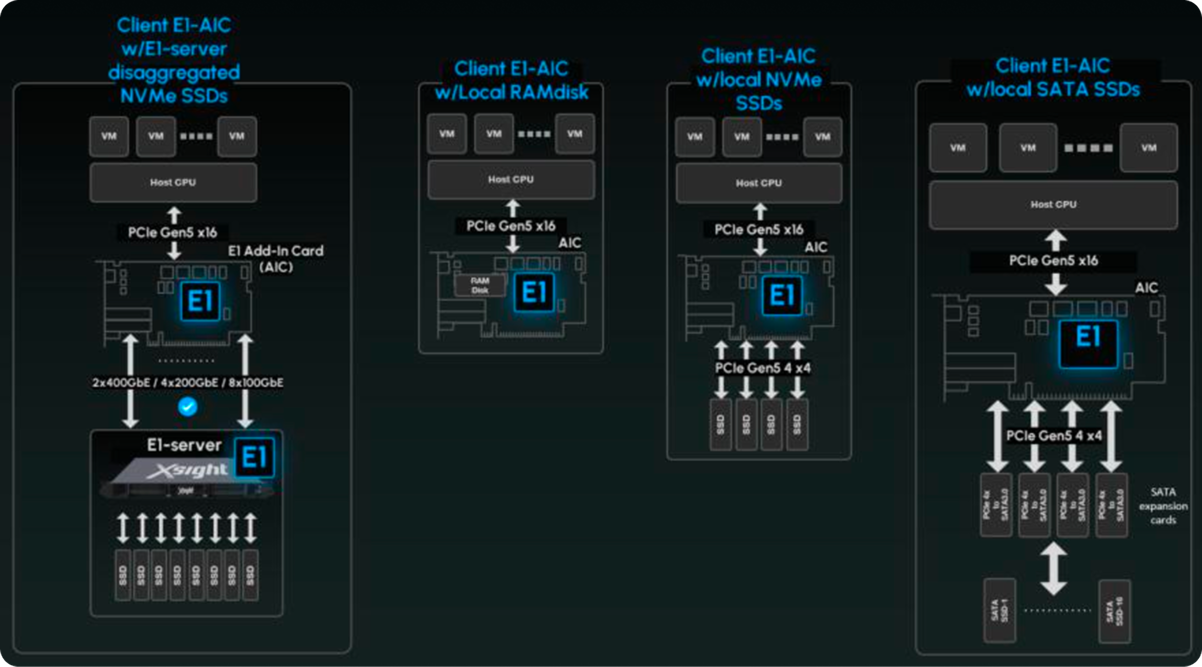
Client E1-AIC with Disaggregated E1-Server Storage
End-to-end NVMe-over-Fabrics (NVMe-oF) storage solution architecture using E1 DPUs on both the client and server sides, supporting both NVMe/TCP and RoCEv2.
- 800GbE E1 DPUs are deployed at both ends of the connection for end-to-end deployment.
- The client-side E1-AIC PCIe endpoint functions as the NVMe-oF initiator.
- The E1-Server's PCIe root complex functions as the NVMe-oF target.
- E1-Server side supports up to eight direct-attached PCIe Gen5 x4 NVMe SSDs.
- Data services such as replication, data reduction, snapshots, clones, and EC can run on either E1 DPU.
- Both initiator and target systems use Linux and/or SPDK software stacks.
Client E1-AIC with Local RAM-disk Emulation
E1-AIC with a RAM-backed virtual NVMe device enables high-performance storage testing, rapid prototyping, eliminating dependency on NVMe SSD hardware availability.
- The E1-AIC emulates NVMe storage devices using local RAM as the backend.
- Designed for maximum performance storage deployment, RAM provides significantly lower latency and higher throughput than NVMe SSDs.
- Enables rapid development, validation, and bring-up without the need for physical NVMe drives.
- E1-AIC is connected to the host via PCIe Gen5 x16 and presents the RAM-backed storage as an NVMe device to the system.
Client E1-AIC with Local SATA SSD Expansion
E1-AIC support for cost-effective SATA SSD deployments through PCIe-to-SATA expansion cards, extending the solution beyond NVMe-based storage.
- Enables high drive-count configurations for capacity-focused workloads.
- Supports up to 16 SATA SSDs attached to the E1-AIC.
- Each PCIe/SATA expansion card supports four SATA SSDs.
- SATA expansion cards connect through PCIe Gen3 x2 interfaces.
- The E1-AIC PCIe interface can enumerate and auto-negotiate down to support these SATA expansion configurations.
- The E1-AIC is connected to the host via PCIe Gen5 x16.
Client Options for Disaggregated NVMe SSDs
Illustrated below are three client-side deployment models for accessing disaggregated NVMe SSDs over a 400G Ethernet network using NVMe-oF with either TCP or RoCEv2 transport.
Option 1
Traditional host-based NVMe-oF initiator with no E1 DPU deployment
The application runs on the Host CPU. The NVMe-oF initiator runs in the host kernel or via user-space SPDK. A standard NIC connects the CPU host to the storage network; this is the conventional software-based NVMe-oF architecture.
Option 2
DPU provides both NVMe and NVMe-oF Linux drivers.
The E1 DPU hosts the NVMe-oF initiator. The DPU presents NVMe storage to the Host CPU via its NVMe target. Network and storage processing are offloaded from the Host CPU to the E1. Reduces host overhead while maintaining standard NVMe device visibility to the application.
Option 3
Full DPU application offload.
Both the application and NVMe-oF initiator run directly on the E1 DPU. The Host CPU plays a minimal role in storage infrastructure, leaving more compute processing power for tenants.
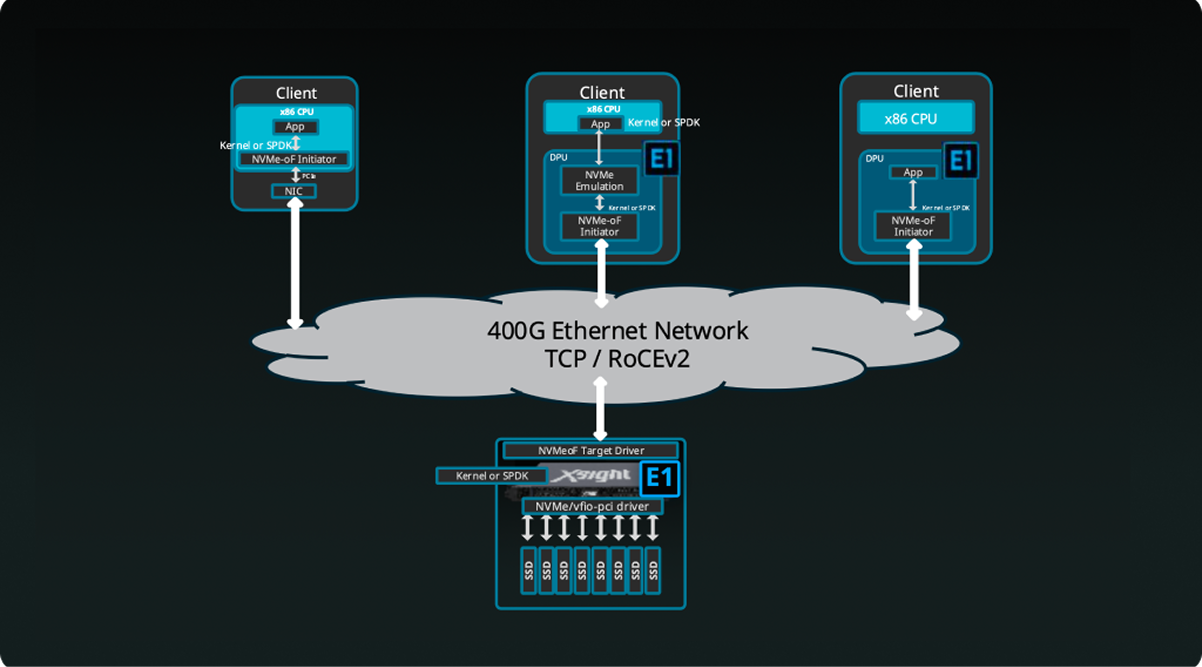
E1-based Storage Server Target
- Storage server equipped with an E1 DPU, in PCIe root-port mode, exposes up to 8 NVMe SSDs
- Software can be implemented using either Linux kernel drivers and/or SPDK
Accelerate Features
What’s Next
Modern data centers require a paradigm shift in how storage infrastructure balances extreme performance demands against power boundaries and CPU overhead.
By anchoring into the broader Xsight Accelerate software-defined framework, Xsight's Accelerate Storage Solutions break down traditional storage deployment bottlenecks. The flexible deployment architectures and advanced hardware offloads powered by the E1 DPU deliver unmatched line-rate efficiency and agility, laying down a robust, future-proof foundation capable of scaling alongside the next generation of data- intensive enterprise, cloud, and AI storage workloads.
Ready to accelerate your storage architecture and transform your infrastructure efficiency?
Contact our engineering and product teams today to access ready-to-use software assets, technical documentation, performance benchmarking, architectural blueprints, and starter development kits.