
Today we are announcing the latest additions to the Xsight Accelerate Network Packet Broker (NPB) solutions on the 12.8 Tbps X2 platform: programmable packet manipulation and stateful mirror-on-drop. As data-center networks evolve to support customized protocols, massive AI/ML workloads, telemetry, and application-specific traffic requirements, the limitations of traditional networking hardware are becoming increasingly apparent. In distributed AI workloads, network delays directly contribute to GPU waiting times, reducing overall compute utilization and hindering performance.
Choosing X2 over other switches is not simply a choice between high-performance switches; it is a choice between a rigid, predefined pipeline and a fully programmable switching platform optimized for AI, storage, and compute networks.
The Power of Programmable Packet Manipulation
Say that five times fast.
Traditional networking switches rely on highly optimized, fixed-function packet-processing pipelines. While they provide excellent throughput and predictable latency, their packet-processing behavior is largely determined by the switch silicon. If a customer needs a new packet format or an operation not supported by the existing pipeline, they must depend on software workarounds or wait for a future hardware generation.
The X2 architecture eliminates this by replacing fixed functions with fully SW programmable functions.
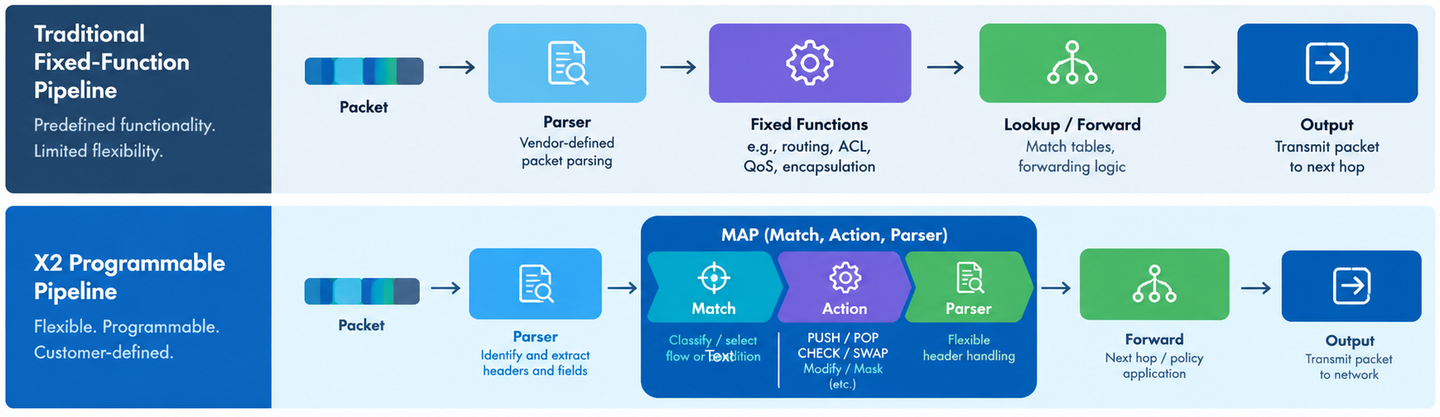
A fixed-function pipeline compared with the X2 programmable pipeline.
The MAP is a programmable packet processing engine, which enables powerful packet manipulation, the ability to inspect, modify, add, remove, validate, or extract information as packets move through the network data plane. Common MAP actions include:
- PUSH / POP: Add or remove headers and packet information.
- CHECK: Inspect and validate packet information or conditions.
- SWAP: Exchange or replace specific packet fields.
- MODIFY / MASK: Change or selectively operate on fields.
- SLICE: Extract selected portions of a packet.
- TIMESTAMP: Add precise timing information for measurement and custom telemetry.
Why Programmability Matters for AI and Hyperscale
AI infrastructure increasingly depends on high-bandwidth, low-latency communication between massive clusters of GPUs and servers:
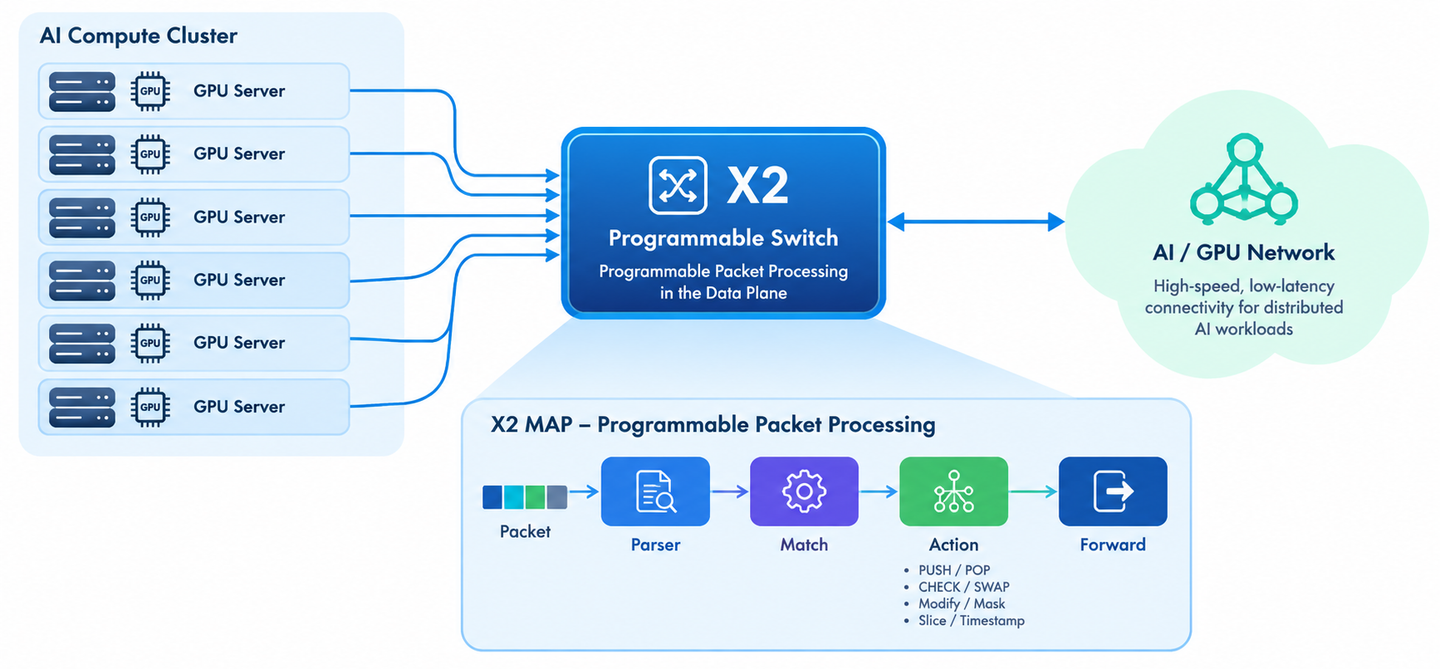
GPU servers connect through the X2 programmable switch, which handles packet processing in the data plane.
By executing packet manipulation functions directly in the hardware pipeline, X2 delivers vital CPU offload, freeing host CPUs from packet-processing burdens. This lowers latency, increases throughput, and allows operators to adapt to new proprietary protocols without requiring new fixed-function silicon.
A fixed-function pipeline vs. the X2 programmable pipeline
Rethinking Visibility: Programmable Mirror-on-Drop
In many networks, a packet drop is primarily visible as a simple counter increment, leaving the operator to guess what happened by reconstructing surrounding telemetry.
X2 takes a fundamentally different approach. Because packet processing, congestion handling, and forwarding decisions are closely coupled, the X2 MAP program can generate diagnostic information exactly at the point a drop decision is made. The X2 Active Queue Management (AQM) engine provides indications like Discard, Mirror-on-Congestion, and uBurst detection. These are recommendations, not hard-wired behaviors, allowing the MAP logic to decide how they are processed.
Rich Telemetry Without the Overhead
Instead of silently losing diagnostic context, X2 generates a mirror containing the exact information needed. Because the architecture supports programmable header manipulation, operators can truncate the payload, saving vital bandwidth, and encapsulate the mirrored packet in a custom telemetry header.
X-VIEW supports triggering this telemetry with profound context. The mirrored packet can answer not just which packet disappeared, but where, when, and under what queue conditions it disappeared, including egress queue fill levels and exact drop reasons.
In a large-scale network, a persistent failure or heavily dropping flow could generate an excessive stream of identical mirror packets, overwhelming the telemetry collector.
X2 solves this by supporting stateful mirror-on-drop. Operators can build suppression or throttling logic directly around the drop-mirroring policy. Using compact state mechanisms like a bloom-filter-like structure or flow signature table, the pipeline can remember that a specific drop has already been reported.
Operators can tailor policies to:
- Mirror the first drop for a flow in full.
- Suppress, sample, count, or rate-limit subsequent drops matching that same state.
- Report again only after a programmable time window or threshold.
How Programmability Changes your Network
The combination of programmable packet processing, flexible header generation, and stateful suppression is why Accelerate Network Packet Broker solutions offer a clear advantage over rigid switching architectures, giving hyperscale and AI operators the agility to evolve as fast as their networks demand.
In August we announced our tunnel handling solution as part of the portfolio and now we are expanding to add packet manipulation and stateful mirror-on-drop.
The broader X2 design follows a core philosophy across congestion measurement, load balancing, and packet processing: flexibility. X2 moves the operational model from "a packet disappeared somewhere in the network" to "the switch can tell you which packet was affected, why it occurred, what the network state looked like, and exactly how much of that data should be exported."